Conference Proceedings
Get Published. Get Noticed. Get Ahead.
oSTEM is excited to launch our Conference Proceedings — a chance for 2026 presenters to turn their sessions, talks, or posters into something more permanent: a citable paper openly accessible through the oSTEM website and reviewed by a team of volunteers with publishing experience in scientific journals. Conference proceedings serve as a publicly accessible record of the research and ideas shared at our conference. Presenters have the choice to opt-in to contributing to the proceedings, allowing them to gain experience with composing a scientific paper without the pressure of a comprehensive peer-review. It's the kind of thing that looks great on a resume, helps you stand out in internship applications and to job recruiters, and can even connect you with others who stumble across your work while looking for potential collaborators.
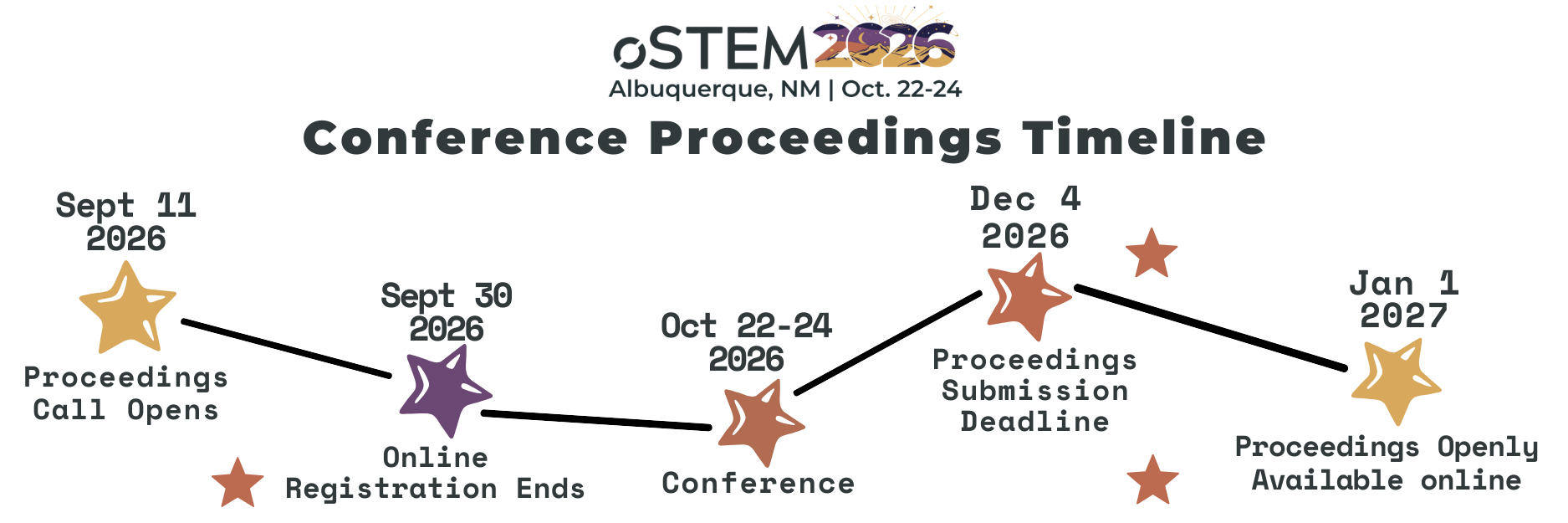
If you are presenting at oSTEM 2026, we'd love to include your voice in this annual collection. Submissions are due December 4th, 2026, and can be submitted to the link below.
Frequently Asked Questions: Your First Proceedings Paper
What are Conference Proceedings?
Conference proceedings are the formally compiled, publicly accessible record of the programming presented at a conference. They consist of written papers developed from presenters' talks or posters, offering a lasting scholarly record of the work shared during the event.
If I present at the conference, do I have to submit a proceedings paper?
No. Proceedings are completely optional. We understand that this can contribute to a time and effort burden on the part of our presenters, so there’s no penalty for not submitting to the conference’s proceedings. Additionally, personal information is required as part of the proceedings submission process, which not all attendees are comfortable with providing.
How long does it need to be?
There is no set limit for a proceedings submission. Some are 3 pages, others can be 12+. It depends on the subject and if the program is publication material. If the number of pages starts to enter dissertation territory, our editorial committee may ask you to trim it down.
What citation style should I use?
oSTEM uses the Harvard citation format. If you've never used it before, don't worry — we’ve included a citation guide here for reference.
Is this the same as being published in a scientific journal?
Not exactly. Proceedings usually undergo a lighter editorial review focused on clarity, as opposed to the rigorous, multi-round peer review journals require. While an oSTEM editorial committee will complete a double-blind review of your work, this is more about catching errors and polishing your writing than a formal, high-stakes peer review. Specifically, proceedings are generally considered a way to share preliminary work before submitting a more polished version to a journal later.
What sections do I need to include?
Most proceedings follow a pretty standard structure: Introduction, Body of Manuscript: which can include subsections such as Methods and Results/Discussion, Conclusions, Acknowledgments, and References. oSTEM’s submission form includes a downloadable template with our current formatting guidelines.
Can I still publish this research in a journal later?
Possibly, but you will need to check with your target journal first. Some journals consider a conference proceeding a prior publication, which can affect whether they'll accept your paper later.
Will my name be publicly associated with this?
Yes. oSTEM’s proceedings will be publicly accessible after the conference, so your name and paper will be visible online. If that's a concern for you, it's worth considering opting out until a later time, as we do not allow anonymous submissions.
What if I'm not confident in my writing?
That's exactly what the review committee is for. First-time writers are welcome, and the goal is to help you build this skill in a low-pressure environment while still earning a final, citable product — not to expect a polished academic voice right out of the gate.
When is it due, and when will it be published?
Submissions are due December 4th, 2026, with plans to make everything available online around the new year.
What are oSTEM’s policies on AI usage?
oSTEM has only two policies regarding proceedings submissions. They are detailed as follows:
oSTEM Plagiarism Policy: Submissions that fail to properly cite sources or source material referred to in the article, or that cite nonexistent sources, will be immediately disqualified from publication for the year. Authors may not be notified in the event of disqualification from plagiarism.
oSTEM AI Policy: We ask you to limit AI use to editing your work, such as spelling, grammar, or sentence structure. Ultimately, using AI to prepare application materials is at the discretion of the authors, but be aware that submissions may be disqualified from publication if they violate oSTEM's plagiarism policy. Your application will NOT be submitted to an "AI-checker."